
Flexitank
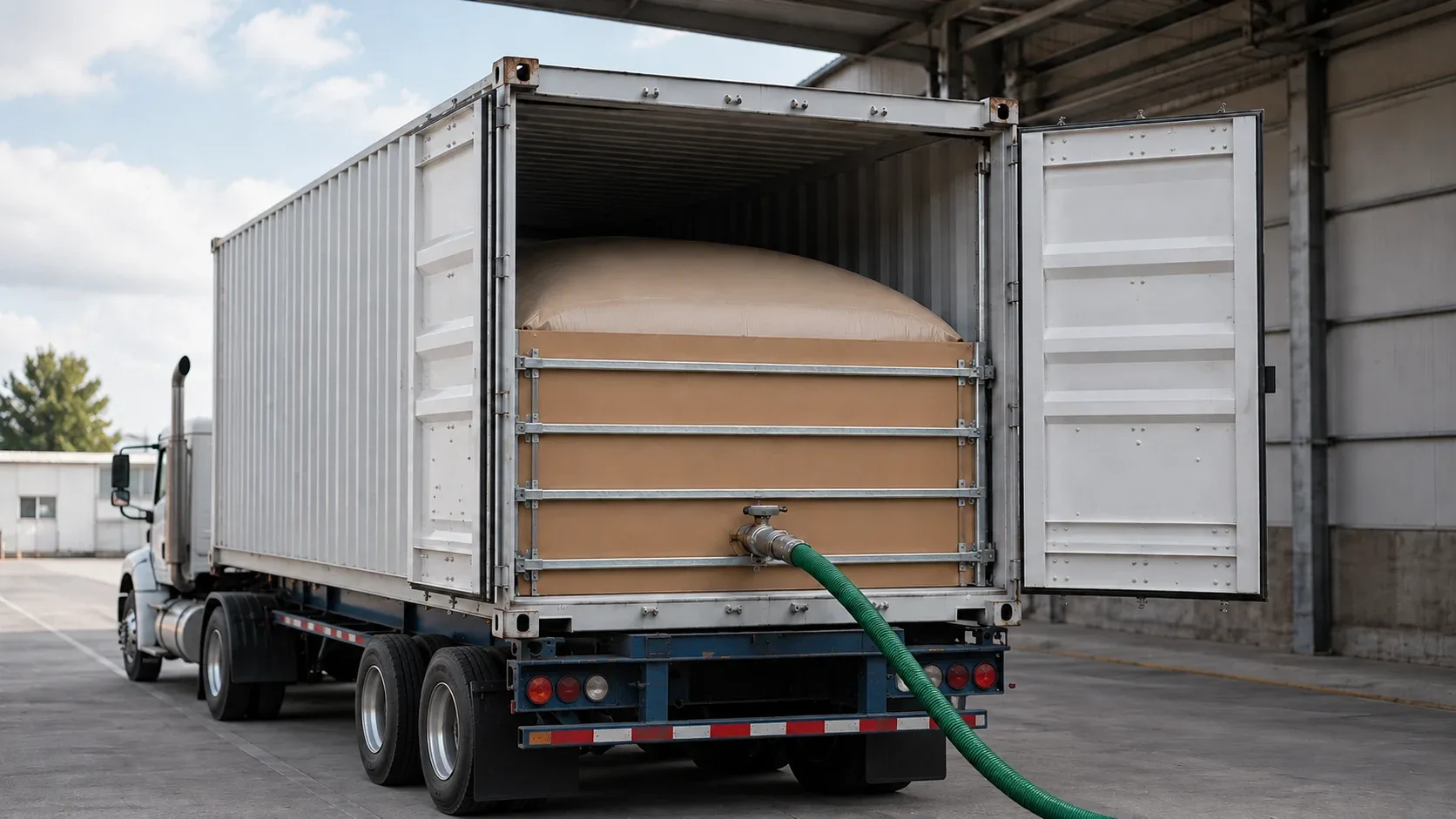
A flexible liner installed in a suitable container by qualified providers. It can work well for compatible nonhazardous liquids on an approved lane.
Bulk Liquid Export
We plan flexitank and packaged-liquid exports from origin through ocean and final delivery—working with qualified equipment providers on the technical side, and GlobalTranz and ExFreight on the freight side.
When it fits
Bulk-liquid feasibility starts with the product and the facilities at both ends—equipment comes after that, not before.
Equipment and packaging
Suitability comes down to the product itself—volume, density, temperature, and hazard classification—matched against the lane, carrier acceptance, and what the loading and receiving sites can actually handle.
A flexible liner installed in a suitable container by qualified providers. It can work well for compatible nonhazardous liquids on an approved lane.
Specialized tank equipment that may suit products, temperatures, or lanes where a reusable tank is the better fit.
Packaged units that may fit smaller volumes, divided deliveries, or receivers without a bulk-discharge setup, with more packaging and handling per unit.
A middle ground for shipments that need more handling flexibility, or when the volume or the site doesn't support a bulk format.
What we coordinate
We manage the handoffs across product, equipment, and transportation, while the technical equipment work stays with qualified providers.
Gather the product specification, safety data, density, temperature, volume, and handling needs.
Find a suitable equipment and installation provider for the product and lane.
Confirm that the product, flexitank, container, and route are accepted by the equipment, freight, and ocean-carrier parties.
Arrange the truck or drayage, container positioning, and loading appointment.
Work through access, pumps, hoses, connections, loading rate, weighing capability, and who's responsible for what with the site.
Schedule installation and related technical services through qualified providers.
Use the liquid’s density and expected fill to check container, axle, and gross-weight limits.
Coordinate routing, booking, documentation, and carrier cutoffs through GlobalTranz and ExFreight.
Make sure the receiver’s unloading method, connections, access, and timing are workable.
Follow the equipment, loading, ocean move, and destination readiness from one handoff to the next.
Before equipment is positioned
The first review should uncover preventable problems without asking the shipper to become an equipment engineer.
Planning process
The sequence keeps commercial decisions tied to product suitability and readiness at both ends.
Review the product information, safety data, volume, origin, destination, and timing.
Consider flexitank, ISO tank, drum, or IBC options based on the product, approvals, payload, and cost.
Make sure the shipper can load safely and the receiver has a workable discharge plan.
Align equipment providers, origin transportation, loading appointments, GlobalTranz and ExFreight, and destination parties.
Follow equipment, loading, cutoffs, documents, and destination readiness through the shipment.
Cargo-owner perspective
We've worked with internationally traded oils and lubricants long enough to know a transportation decision can move the product's economics as much as its freight cost.
Payload economics, product value, packaging cost, loading losses, and delivery timing all shape the right transportation plan—not just the freight rate.
Explore ocean export coordinationIndividual qualification
Feasibility depends on the commodity itself—safety data, hazard status, and product compatibility—plus equipment availability, carrier approval, and whether the origin, destination, and current routing conditions actually support the move.
Every liquid, lane, and loading site gets its own feasibility check before equipment is ordered or positioned.
Common questions
A flexitank is a large flexible liner installed inside a suitable shipping container to carry an approved compatible nonhazardous liquid in bulk.
For a compatible product and workable lane, a flexitank may reduce packaging and handling per unit and increase usable liquid payload. The comparison still depends on volume, density, facilities, approvals, risk, and destination needs.
We coordinate with qualified equipment and installation providers—we don't manufacture, install, certify, or physically inspect the flexitank ourselves.
Not every liquid qualifies. Compatibility, hazard status, temperature, equipment approval, carrier rules, the lane, and loading and discharge capabilities all have to check out first—our initial focus is on compatible nonhazardous liquids.
Send us the product name and safety data, the origin and destination, volume and density, expected temperatures, and what each facility can handle.
Yes. We coordinate origin truck or drayage, container positioning, and loading appointments directly, and manage ocean transportation through GlobalTranz and ExFreight, subject to shipment qualification.
Start a conversation
Share the product and safety data, origin, destination, volume, density, loading setup, and timing. We’ll start by checking whether the move is workable.